I got this one half wrong.
For years I told people to put their website on Squarespace, and I knew it was overkill. A database, a CMS and a pencil-icon editor, for fifteen paintings and a phone number. It’s really just taking money off people.
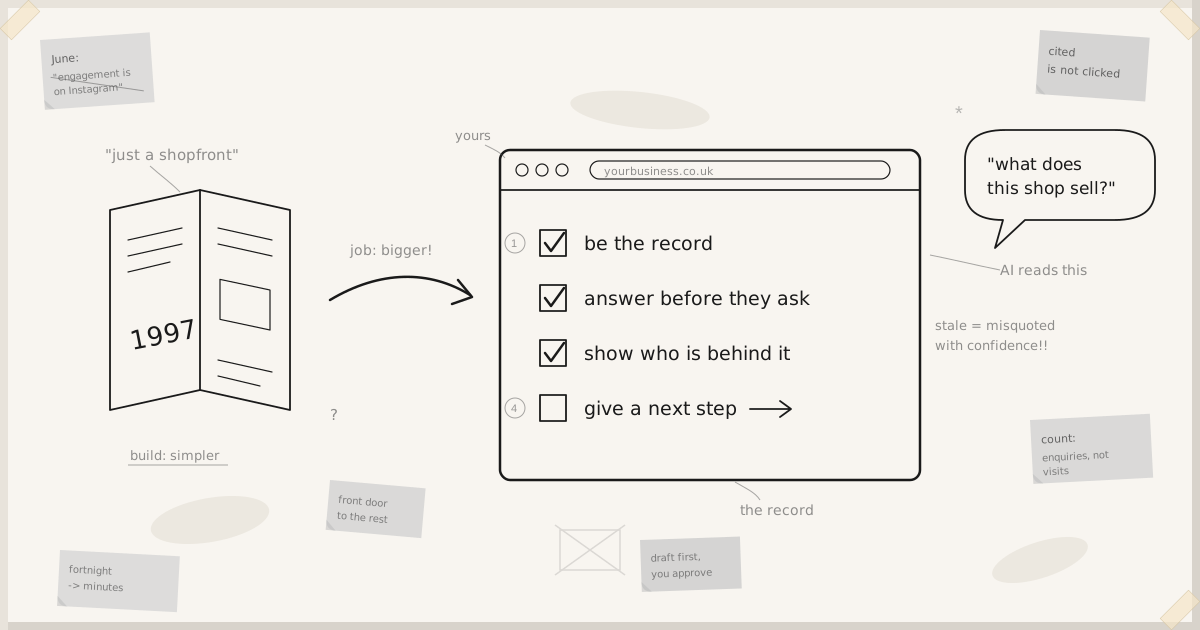
So in June I told Spencer it was "welcome back to 1997". The machine writes the HTML now, so you just generate the site, put it on a CDN and regenerate it when something changes. And I said nobody looks at your website any more, they look at Instagram, so the website is just a shopfront.
The first bit I still believe. The shopfront bit was wrong.
The machines read your website
When people ask Google a question now, there’s often an AI answer above the links, or they skip Google and ask ChatGPT. Pew looked at 68,879 Google searches and found people clicked a result on 8% of visits when there was an AI summary, against 15% when there wasn’t (Pew, July 2025).
Those answers are built from websites, not from your Instagram. So your website is the record. It’s where the AI finds your prices, what you do and whether you’re any good, and if it’s out of date the AI repeats the old stuff to someone deciding whether to buy from you.
Spencer’s mate Justin put it well: social media shows you what the platform wants you to see, so when you want the truth you go to the source. If I want to know what Tracy’s prints cost, I go to Tracy’s shop.
For a lot of people we work with, sole traders and artists mostly, the website is the front page of their working life. It needs to work a lot harder than a shopfront.
Don’t expect the clicks back
Being quoted by an AI is worth having, but in the same Pew data people clicked a cited source on about 1% of visits. So your visitor numbers will probably look worse than things are. I’d count enquiries instead.
The real problem is the cost of change
One of our customers lost about half their sales when their rankings dropped, and spent five months waiting for developers to fix it. Another had just paid for a new site and told us keeping it updated "takes up a lot of our time".
That’s the problem. Every change means finding the pencil icon you last used eight months ago, or waiting a fortnight for a developer and an invoice. So people stop changing things, and the site goes stale.
With Bernard we tried to get the cost of a change down to nothing. You ask for it in plain English, in Bernard or in your own AI. It lands as a draft and nothing goes live until you say so. If it goes wrong you roll it back yourself, because we keep the last 100 published versions. And robots do the boring checking in the background.
Try reading your own site on your phone like a stranger would and note everything that’s out of date. If fixing it all means a fortnight and an invoice, that’s the thing to sort out.
More on how we build this: Reliability With a Team of Two and Building a CMS From Scratch in 2026. And if your website needs to work harder, that’s what Bernard is for.