story
bernard
I Never Thought I'd Make a Web Hosting Company
My Role
Timeline
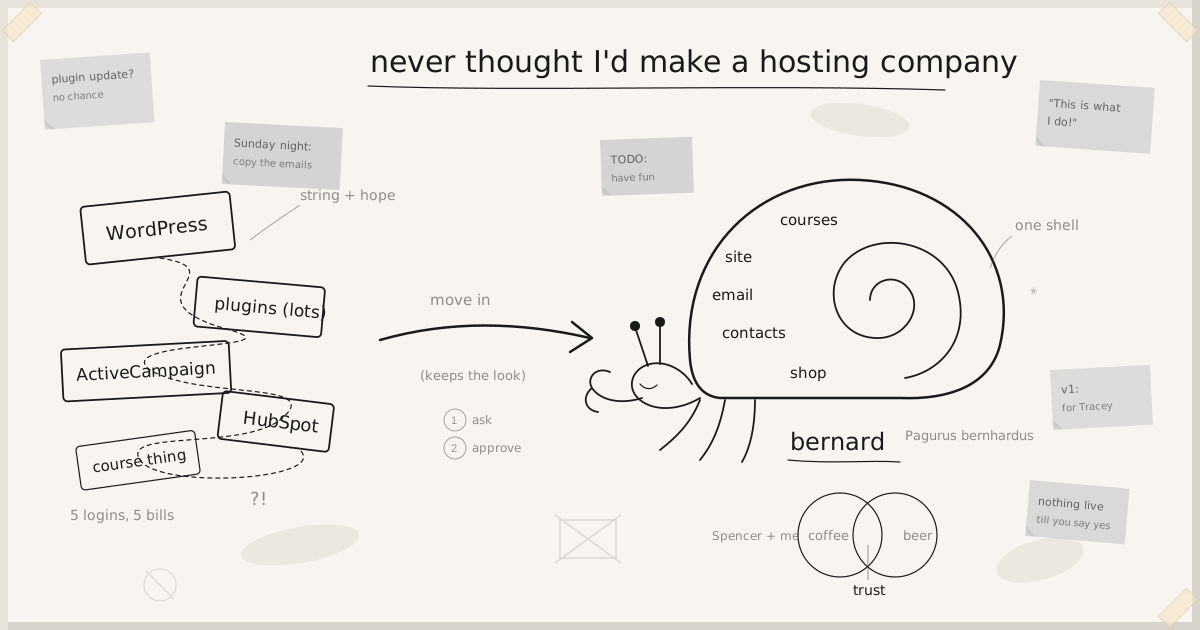
I never planned to run a hosting company. Spencer and I ended up replacing the crappy old systems small businesses are stuck with.
I'm a fractional CTO. I do platform migrations, Bubble cutovers and the unglamorous work of keeping systems up. Web hosting was the last business I wanted to be in. It's crowded and the margins are thin.
And now I run a web hosting company with my friend Spencer. It's called bernard, and I'm having more fun with it than with almost anything I've built.
1. The old systems are crappy
Most small businesses I meet run some version of the same pile. WordPress and a stack of plugins for the site. ActiveCampaign or Mailchimp for email. HubSpot for contacts, usually half set up. A course platform bolted on the side, and Stripe wired into all of it.
Don't get me wrong. Each of those was a good idea once. They were built for a time when you hired a developer to change your website and paid a separate company for each job. The owners I meet still pay for that model, every month.
From the inside it looks like this. There's a plugin nobody dares update, because the last update broke the checkout. The email tool doesn't know who bought the course, because the shop lives somewhere else. And on a Sunday night the owner copies email addresses from one app into another.
2. The company owner is Margaret - who knows everything
Spencer wrote about Margaret, the person in every organisation whose knowledge never makes it into the system. In a small business, the owner is Margaret. Everything about the business sits in one head.
Five apps that don't share data make that one person the integration layer. I've spent 20 years building integration layers. A tired owner on a Sunday night shouldn't be one.
3. Why Spencer and I could fix it
Spencer and I have been friends for a long time. Professionally we overlap almost nowhere. He's spent twenty-five years walking into industries he didn't understand and working out what makes them tick. I build systems. He tells his side in We didn't mean to start a website company, where he describes our Venn diagram as coffee, beer and trust.
Between us we have the skills and the experience. Trust is the overlap, and it matters more than either. I don't second-guess his read on what a business needs, and he doesn't second-guess how I build it. When one of us describes something that looks hard, the other one usually says "This is what I do!"
We also had a lot of fun, and that was deliberate. We didn't start with a business plan. We built something for a friend, enjoyed it, and then other people asked for one. We named it after a hermit crab. Spencer hand-draws woodcuts for it. I think you can feel that in the product.
4. Where it started: Tracey
Tracey is a fashion illustrator with an Instagram audience most brands would pay for. Her Squarespace site couldn't do what she wanted, she couldn't easily improve it, and every platform took a cut when she sold.
At the same time Spencer was hot-gluing Squarespace, Podia, MailerLite and Zapier together for a painter friend. We were solving the same problem from two sides, and neither of us had asked why the website wasn't the place where all of it lived.
So we built Tracey a site she could run herself, by describing what she wanted in plain English.
5. Replacing WordPress
bernard moves your existing site and keeps its look. You don't rebuild it or pick a template, and you never update a plugin again.
After the move you ask for changes in your own words. This week a course owner wrote: "We set a price for the course and published, but we have no buy now button." bernard found two causes. The course was set to free sign-up, and its price was in a different currency from the shop. It explained both and asked what to do. Three short replies later the page was live, with the right price and an Enrol now button. The owner never opened a settings screen.
6. Replacing ActiveCampaign
Your email lives with your site. A newsletter or welcome sequence knows who bought what, because it reads the same contact list the shop writes to. You don't need Zapier to keep two lists in step.
If you're leaving ActiveCampaign, bernard imports your contacts.
7. Replacing HubSpot
When someone buys, signs up or fills in a form, bernard adds them to your contacts. You get one list, next to everything else.
To be straight about it: this is the CRM a small business needs. If you run a sales team of twenty, keep HubSpot.
8. AI-native, for people who don't care about AI
Our customers don't need to know what an AI agent is, and most of them don't want to. They want the thing on their site to change.
Spencer has a rule for this: if a sentence does the job, don't build a settings screen. So we build as few screens as we can.
And the owner stays in charge. Every change goes into a draft first. The owner looks at it and approves it, and we keep every published version. A non-technical owner can trust it because of that step. The first time it works, you get the feeling Spencer describes in I know kung fu, and you want to tell someone.
9. We dogfood it
You're reading this on bernard. Spencer's site runs on it, and so do our clients' sites. Each business we move shows us something that makes the next move easier.
Real businesses find the gaps fast. Last week a shop needed to switch currency, and you couldn't ask bernard for that yet. We did it by hand and added it to the list.
The short version
- The old stack charges you rent for every job and makes you the glue between the apps.
- bernard moves your site as it is, then runs your email, contacts, courses and shop next to it.
- You ask for changes in plain English and approve them before they go live.
- Spencer and I built it on trust, and we enjoyed building it.
If your website feels like a shell you've outgrown, bernard is where the move starts.
