The platform that built both my products to product-market fit eventually became the thing strangling them. Here’s how I knew it was time to leave, and why the AI window made the leaving viable.
Why I rebuilt two products off the platform that got them off the ground.
In Part 1 I laid out the four business questions every software founder should ask. This piece is about what happens before the rebuild: when you’re running on a stack that quietly stops being able to answer them.
For a decade, the right answer to “how do I get a software business off the ground without an engineering team” was Bubble.io. Both of my products started there; Bubble carried them to real customers and real revenue. Then, slowly, it became the thing strangling them.
This isn’t a Bubble-bashing piece. Bubble was the right answer at the start. The point is more general: every platform that gets you to product-market fit eventually becomes the thing standing between you and your next move. Spotting it is a business question, not a technical one.
The four signs the ceiling had arrived
What does it cost to keep the lights on? Bubble’s billing revolves around one thing: WU, Workload Units. Every query, every workflow, every scheduled job is metered. The bill grew faster than the customer count. Exactly the wrong direction.
How many people do I have to hire? None to build. That’s what no-code is for. But every change required understanding the platform’s quirks, undocumented limits, and which plugin had broken since the last update. “No-code means no engineers” quietly replaces engineers with platform specialists.
Whose phone rings when something breaks? Bubble’s, in theory. Mine, in practice. When a plugin maintainer abandons their work or an update changes behaviour, the customer calls me, and my fix is “wait and hope.”
How fast can I respond? This is the one that broke me. In Bubble, every change is a human hand on a visual builder: drag, click, save, test, repeat. There is no agent that can read the codebase, propose the change and ship it. Compared to working with Claude or Codex on a real codebase, Bubble development is painfully slow. The gap isn’t 2×. It’s an order of magnitude.
The WU tax: designing the app around the meter
The cost question deserves a second look because of where the money actually went. It wasn’t the plan tier. It was the engineering time I spent making the app not consume too much WU.
Every growth spike meant days of defensive engineering: caching results, restructuring data, splitting workflows, building satellite apps to offload work, rewriting search patterns that suddenly cost real money. The billing model quietly became the thing I was designing the product around, instead of designing it around customers.
That time felt expensive before. In the light of Claude and Codex, it feels obscene. Every hour I spent hand-optimising a Bubble app to dodge WU charges was an hour I could now spend shipping actual features on a real codebase with an AI agent doing the typing.
The question that ended the conversation
The hardest cap was a sales one. For a corporate buyer with a security team, the honest Bubble answer to “where does our data live?” was: “on a shared platform with hundreds of other apps, no data residency, no self-hosting, no clean SOC 2 story.”
That doesn’t end conversations. It ends deals. A whole tier of customer was unreachable as long as that answer stayed the same.
The AI window that changed the math
Two years ago, the rebuild wasn’t viable: twelve to eighteen months of engineering time I didn’t have and couldn’t hire for. So I worked around the platform instead.
What changed is the AI tooling. Claude and Codex collapse the cost of building a whole product by one person. The cost of rebuilding fell below the cost of continuing to work around Bubble, and every hour I now spend in a real codebase compounds, instead of buying me another month of WU breathing room.
What the rebuild bought me
- Days collapse to hours. Hours collapse to minutes. What used to be a long slog through a visual builder (point, click, drag, test, repeat, hope nothing else broke) is now a working session with Claude or Codex on a real codebase. The cost of change itself has dropped by an order of magnitude.
- A customer-acceptable answer to “where does our data live?”: an unlock for an entire market segment.
- No WU meter, no plugin lock-in: every part of the stack is something I can swap, and nothing is metering my queries.
- Version control, CI, preview deploys, type safety: the boring infrastructure that makes change cheap and confident.
- A codebase Claude and Codex can read: the team-of-one model only works because AI tools work on plain code, not visual builders.
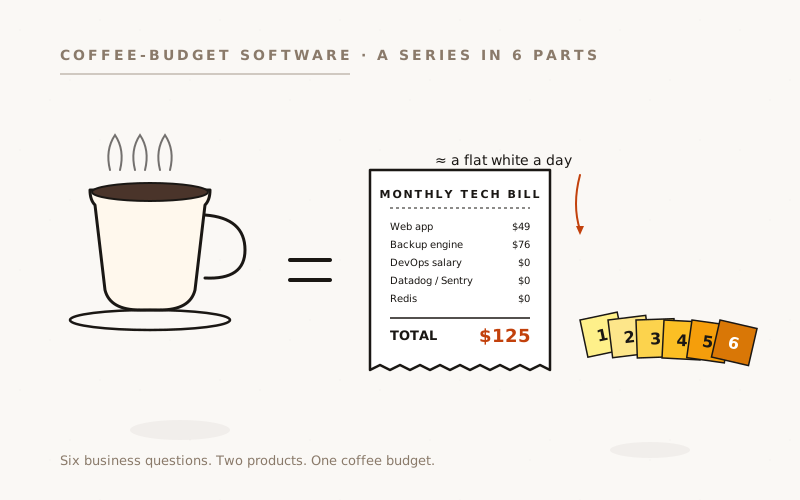
- $49 a month of AWS instead of an open-ended Bubble bill.
The general lesson
The point isn’t “leave Bubble.” It might still be the right answer for your business, especially if you’re earlier than I was, or selling to a market that doesn’t care about the questions above.
Don’t confuse the platform that got you here with the foundation you build the next decade on. Every platform has a ceiling. Notice when you’ve hit it, do the maths on what the AI window has changed, and decide.
For me, the maths was clear.